
Treatments That Come To You

Every treatment described here can be delivered in your own home, and at-home appointments are provided at no additional cost. A Lipo Freeze practitioner arrives with the equipment in transport cases, sets up in whichever room you have chosen, carries out the session, and packs everything away before leaving. The same consultation questions, contraindication checks, applicator settings and aftercare guidance apply as they would on fixed premises. For many people a home visit removes the biggest obstacle to trying non-surgical treatments at all, which is not cost or nerves about the technology but the logistics of reaching an appointment during a working week.
What the practitioner brings and what you provide
The practitioner travels with the device, its applicators and cabling, single-use gel pads or membranes where required, cleaning materials, and in most cases a folding couch. What is asked of you is modest: enough clear floor space to open a couch and walk around one side of it, an accessible mains socket, somewhere to wash hands, and a door that closes. A dining room, a spare bedroom or a corner of a living room all work.
Making the space work in a flat or a house share
Small homes are not an obstacle. The requirement is enough clear floor to open out a couch and walk around one side of it, which most rooms yield once a coffee table has been moved. Mention stairs or restricted parking in advance, since equipment cases are heavy, and settle pets elsewhere, because cabling runs across the floor.
Privacy is often the reason people choose a home visit rather than a convenience. Treatments involving the abdomen, the pelvic floor or intimate areas involve exposure that many find easier to manage in their own bathroom and their own dressing gown. The Lipo Freeze approach is built around that rather than treating it as an afterthought, and the wider service is outlined on the Lipo Freeze homepage.
Consultation And Assessment
Nothing begins until a consultation has taken place. It covers three things: what you are hoping to change, whether the treatment you have in mind can produce that change, and whether anything in your medical history makes it unsuitable for you specifically. Any one of the three can lead to the conclusion that a treatment is the wrong choice, and a Lipo Freeze practitioner will say so rather than proceed.
A Lipo Freeze practitioner takes medical history in detail: medication, any diagnosed circulatory, cardiac or neurological condition, previous surgery near the area, implanted metal or electronic devices, pregnancy or breastfeeding, and any condition triggered by cold. Each question maps onto a specific exclusion below, and answering fully is the most useful thing you can do to keep the session safe.
Assessing the area itself
For fat freezing the practitioner assesses the tissue by hand. The question is whether the fat is subcutaneous, pliable and able to be drawn into an applicator cup. Firm fat sitting deep behind the abdominal wall does not respond to cooling in the same way. Skin quality matters too, since an area with substantial loose skin may look no better once fat beneath it has been reduced.
Measurements and, with your consent, photographs are usually taken at the start of a course, because contouring changes are gradual and human memory judges them poorly. Typical timelines and the factors that shape an individual outcome are set out on the results and expectations page, which is worth reading before a course begins. Published fat freezing prices, and an explanation of how treatment areas are counted, are set out on the prices page; fees for the other treatments are confirmed at consultation.
Setting expectations honestly
Results from every treatment here are typical rather than guaranteed and vary between individuals. Baseline tissue characteristics, hydration, activity levels, hormonal state and ordinary biological variation all appear to matter, so a practitioner who tells you exactly how many centimetres you will lose is guessing. None of these treatments substitutes for medical care; if your concern is a diagnosed condition rather than a cosmetic one, the first step is a conversation with your GP.
Suitability for any treatment described here can only be established at a professional consultation. Reading a page is not an assessment, and no treatment should be undertaken on the basis of web content alone.
Fat Freezing: How Cryolipolysis Works
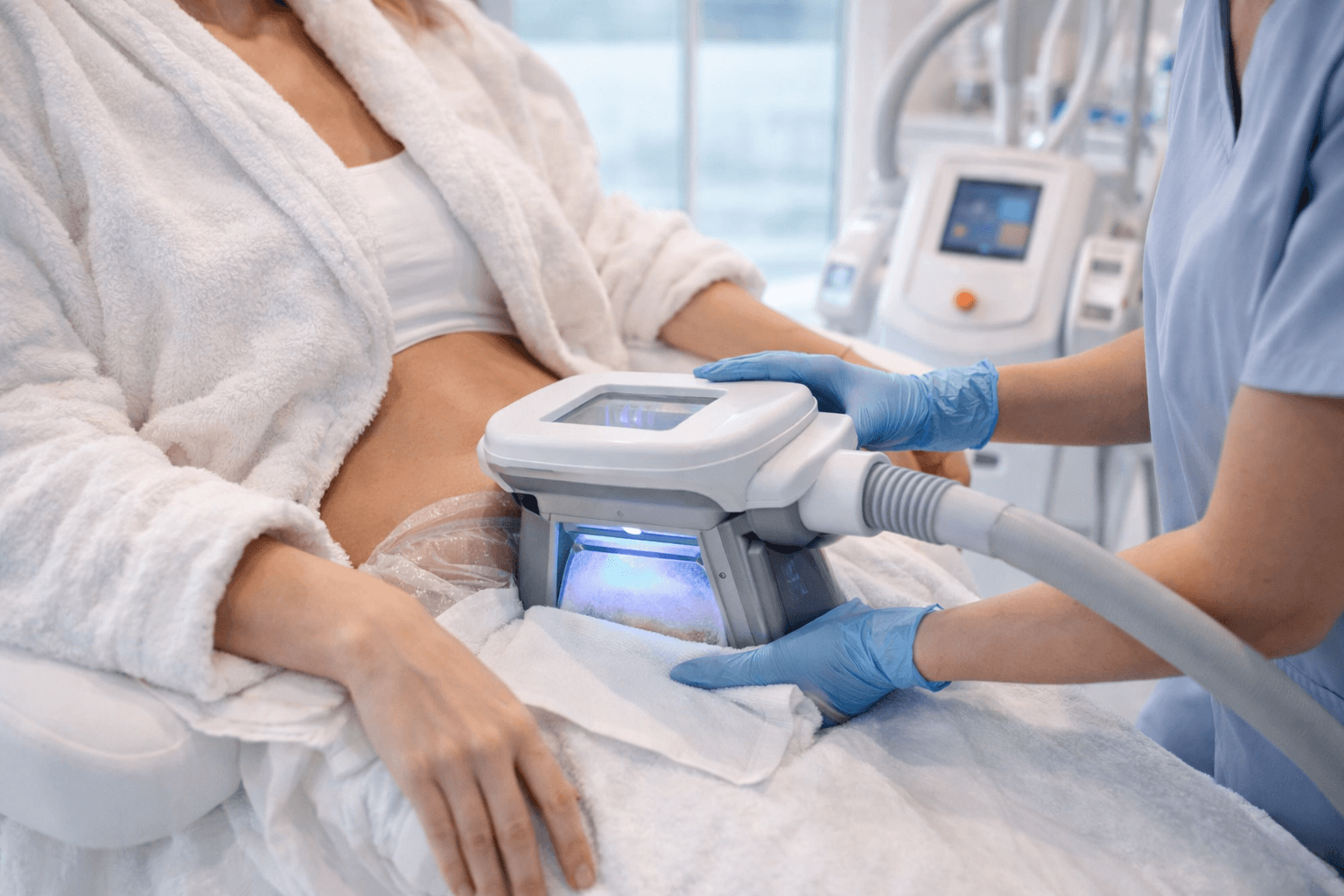
Cryolipolysis, the treatment most people mean when they say Lipo Freeze, is a non-surgical procedure that targets and reduces pockets of stubborn fat using controlled cooling, with no needles and no anaesthesia. It is described as low-risk when carried out by a trained practitioner using certified equipment, which is a narrower claim than calling it safe outright. It rests on a difference between tissue types: fat cells are more sensitive to cold than skin, muscle or nerve tissue, and can be brought to a temperature that damages them whilst the structures around them remain unharmed. That selectivity is the entire basis of the treatment.
The three stages
- Application. A gel pad protects the skin and the cooling applicator is positioned over the target area, gently drawing the fat tissue up into its cup so that it sits within the cooling plates rather than merely beneath them.
- Freezing. Controlled low temperatures trigger apoptosis, the natural process of programmed cell death, in the fat cells within the treated pocket, whilst surrounding structures are not damaged.
- Elimination. Over the following weeks your body gradually clears the destroyed fat cells through the lymphatic system.
That last stage matters more than it first appears. The treatment does not remove fat during the session; it initiates a process your own body completes over months. The useful consequence is that change appears gradually enough to look natural. The inconvenient one is that patience is required.
Fat freezing is a contouring treatment, not a weight-loss treatment. It reduces localised pockets of fat in a specific area, and the number on a set of scales may not change at all.
Fat Freezing: Areas, Sessions And Timeline
The areas that can be treated are those where fat sits in a discrete, liftable pocket: the upper and lower abdomen, the love handles, the upper and lower back including back rolls, the inner and outer thighs, and the upper arms. Applicator size and shape are matched to the area. Areas where fat is thin, firmly bound down or lying deep behind muscle are poor candidates regardless of how much you would like them treated.
What a session involves
Once the applicator is in place the sensation begins with intense cold accompanied by tugging or pressure as tissue is drawn into the cup, which is unfamiliar rather than painful. Numbness typically develops within minutes, after which most people read or talk for the remainder. When the applicator is removed the tissue is cold and firm, and a brief massage of the area is standard practice.
Many clients see good results after one session, though additional sessions may benefit certain goals or areas. Whether one or several are appropriate is judged at consultation on the basis of the area, the volume of fat present and what you want to achieve. A Lipo Freeze practitioner would rather treat one area properly than spread a session thinly across three.
When results appear
Visible improvements typically begin at around three to four weeks, with optimal results generally seen between eight and twelve weeks. Elimination continues for up to four to six months, so a result judged at twelve weeks may still improve beyond that. This timeline is the most common source of disappointment among people not told it clearly, because they judge the treatment at week two and conclude nothing has happened.
Permanence
Once fat cells are frozen and eliminated they do not return, which distinguishes cryolipolysis from treatments that shrink fat cells temporarily. The qualification is that the result is permanent only if your weight remains stable, since the cells remaining in the area can still enlarge and cells elsewhere are unaffected. New fat is less likely to accumulate in the treated area, but significant weight gain will still change its shape.
There is no significant downtime: you can resume normal activities, drive and exercise immediately. Staying hydrated supports the lymphatic drainage on which the result depends.
Fat Freezing: Suitability And Side Effects
The treatment suits people close to their ideal weight with localised stubborn fat that has not responded to diet and exercise, who want non-surgical contouring without needles or recovery time, gradual and natural-looking improvement rather than an abrupt change, and a long-lasting rather than temporary reduction.
When fat freezing is not appropriate
- Cold-related conditions, specifically Raynaud's phenomenon, cold urticaria and cryoglobulinaemia. These are absolute exclusions, because the treatment works by sustained cold exposure.
- A hernia at or near the intended treatment site, given the suction the applicator applies.
- Pregnancy or breastfeeding.
- Excessive loose skin in the target area, or too little fat present for the applicator to draw up effectively.
- Being significantly overweight, where the appropriate route is a weight-loss intervention rather than a contouring treatment.
These exclusions are not negotiable. Where one applies, a Lipo Freeze practitioner will decline to treat the area and explain why. In some cases another treatment on this page will be suitable where fat freezing is not, and that is worth exploring rather than abandoning the idea.
Side effects
Common side effects are temporary and local: redness, swelling, bruising, tingling and numbness. Slight tingling, aches or tenderness can persist for several days up to about a week. Numbness in particular can linger longer than people expect and is not a cause for concern in itself. None ordinarily interfere with normal daily activity.
Rare side effects should be understood before treatment rather than after. Paradoxical adipose hyperplasia, abbreviated to PAH, is a response in which the treated area accumulates more fat rather than less. Skin pigmentation changes have been reported. Frostbite is extremely rare where correct protocols and protective gel pads are used, which is why the gel pad is non-negotiable.
Paradoxical adipose hyperplasia is rare, but it is a recognised outcome of cryolipolysis. Any unexpected firm enlargement of a treated area in the months following a session should be reported to a medical professional.
Body Toning With HIFEM
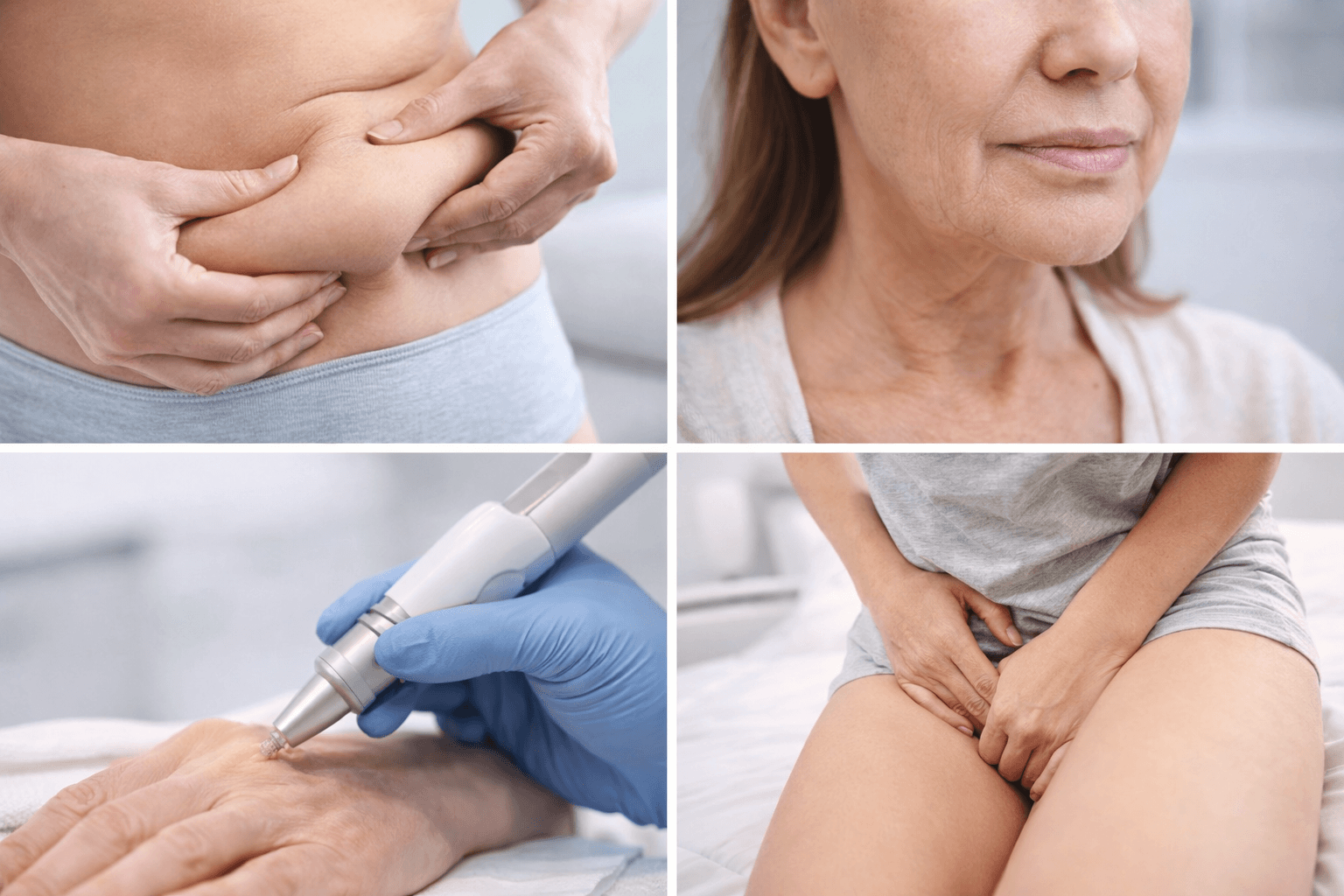
Body toning is the second contouring treatment a Lipo Freeze practitioner offers, and it addresses a different problem. Where cryolipolysis reduces a pocket of fat, body toning builds and conditions the muscle underneath it. The technology is High-Intensity Focused Electromagnetic energy, shortened to HIFEM, which induces supramaximal muscle contractions. These are deeper and more complete than you can produce voluntarily, because they are driven by the applicator rather than your own nervous system, bypassing the limits your brain imposes on effort.
Muscle fibre recruitment
The reason this matters is recruitment. During conventional exercise an amateur athlete contracting a muscle group hard typically recruits only thirty-five to forty per cent of the available fibres. HIFEM achieves close to complete fibre recruitment, engaging what voluntary effort leaves untouched. A single thirty-minute session generates up to twenty thousand contractions, and these affect fat cells in the overlying tissue as well as the muscle itself.
The figures associated with the technology are a fat reduction of up to nineteen per cent and an increase in muscle mass of up to sixteen per cent, with visible results possible within three weeks. These are reported outcomes rather than promises. The mechanism is a training effect, and such effects reward consistency more than intensity.
Areas and course structure
Treatable areas are the abdomen, buttocks, hips, arms including biceps and triceps, thighs across the front, back and outer aspects, and calves. For people particularly concerned with loose or under-defined upper arms, the Lipo Freeze 2U Arm Toning Treatment provides more information about the approach used specifically for this area. Each session lasts thirty minutes. The recommended protocol is a minimum of four sessions and ideally six or more within about two weeks, spaced at least two days apart.
Muscle gains are generally visible within two to four weeks. The fat reduction component is slower and becomes noticeable at around three months. Results are described as lasting six to twelve months where a reasonable level of activity is maintained where supported by ongoing general fitness, and fade as any training adaptation fades if activity stops. Expecting a course-length outcome from a single session is the most common misunderstanding a Lipo Freeze practitioner has to correct.
Diastasis recti and injury recovery
Two applications sit apart from general contouring. The first is diastasis recti, the separation of the abdominal muscles that commonly follows pregnancy; by strengthening the abdominal musculature the technology has been reported to reduce the separation by more than ten per cent. A conversation with your midwife, health visitor or GP alongside treatment is sensible here, particularly in the first months after birth.
The second is injury recovery, where increased blood circulation and muscle stimulation can support healing alongside physiotherapy. The important word is alongside: this is an adjunct to a rehabilitation programme designed by a clinician, and an existing muscle injury in the area you want treated is itself an exclusion.
When body toning is not appropriate
- Metal implants or orthopaedic hardware in or near the treatment area, and implanted electronic devices.
- An intrauterine device, where abdominal or pelvic treatment is being considered.
- Pregnancy or breastfeeding.
- Bleeding disorders, cardiac conditions, pulmonary insufficiency and epilepsy.
- Taking blood-thinning medication.
- The device is not used near the chest, neck or head.
- Active malignancy.
- An active hernia, or an existing muscle injury in the area to be treated.
- Being under eighteen years of age.
There is no downtime. Some people notice mild tenderness, but the delayed soreness that follows a hard gym session is generally absent. Avoiding strenuous exercise for a day before and after each session is advised.
Vaginal Tightening With HIFU
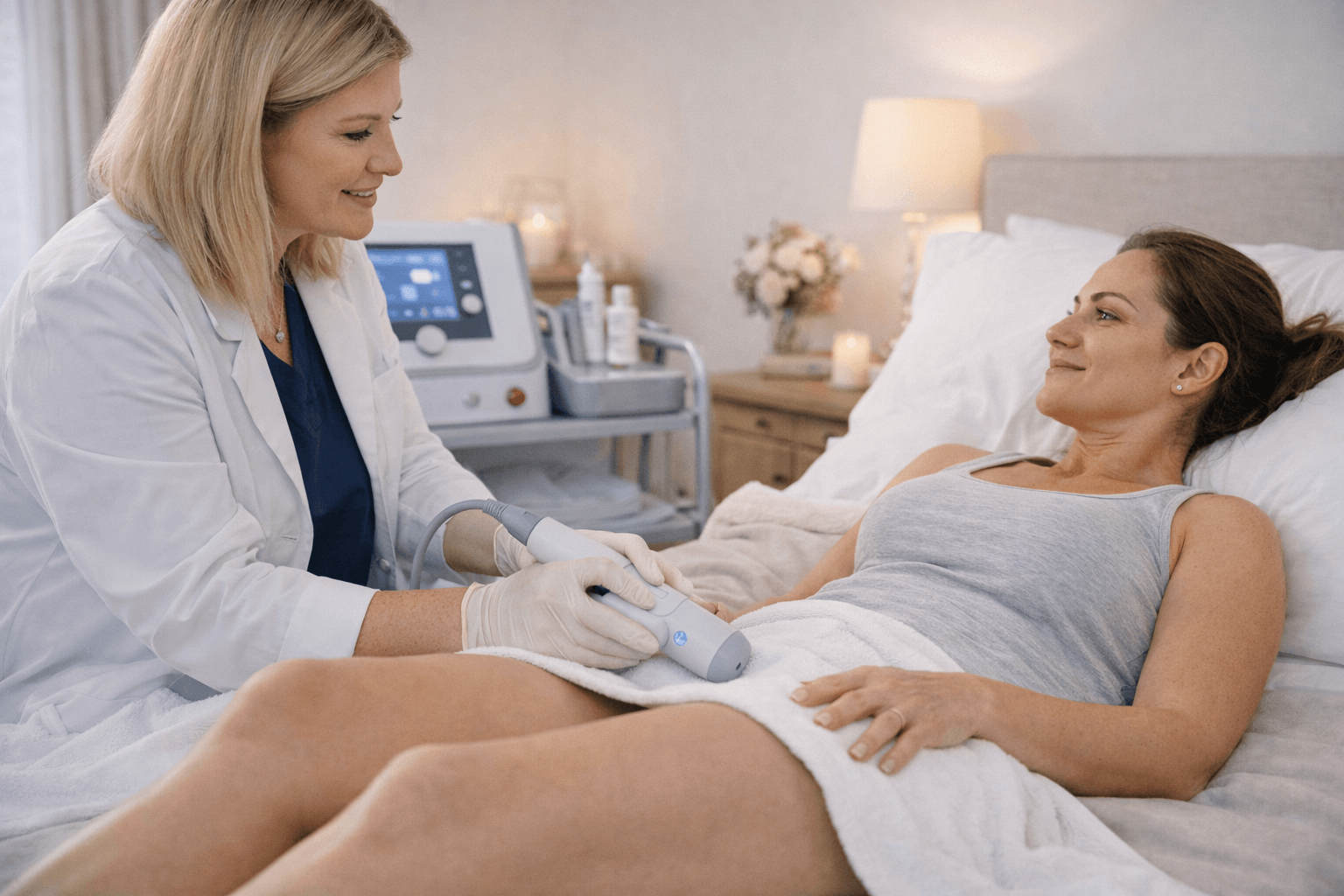
The Lipo Freeze vaginal tightening treatment uses High-Intensity Focused Ultrasound to stimulate collagen, improve elasticity and support pelvic floor function, without surgery or downtime. The same HIFU technology is also used for facial rejuvenation; you can learn more about the Lipo Freeze 2U HIFU Non-Surgical Facelift treatment and how focused ultrasound is used to support firmer-looking skin. Focused ultrasound energy heats the tissue below the surface, stimulating natural production of collagen and elastin whilst leaving the surface layer undamaged.
How a session is structured
- Consultation, in which medical history and your wellness goals are evaluated.
- Preparation, in which a topical numbing cream is applied for comfort and given time to take effect.
- Treatment, in which focused ultrasound energy is delivered using a specialised HIFU wand, taking approximately thirty minutes.
- Collagen activation, the biological response the energy sets in motion, which continues after the session ends.
- Recovery, with minimal downtime and possible mild soreness or swelling lasting a few days.
Many women benefit from three treatments spaced around four to six weeks apart, though individual variation applies. The spacing is dictated by collagen biology rather than convenience: new collagen takes weeks to lay down and mature.
Reported benefits
- Increased tightness and improved elasticity.
- Improved sexual satisfaction and function.
- Reduced vaginal dryness through enhanced natural lubrication.
- Alleviation of incontinence.
- Relief of pain during intercourse.
- Improved confidence and well-being, with no anaesthesia required.
Intercourse should be avoided for twenty-four to forty-eight hours afterwards, and adequate hydration maintained, since natural healing and collagen formation depend on it. Results are not permanent, and maintenance sessions may be needed roughly annually. The treatment suits women experiencing vaginal laxity, mild stress incontinence, or loss of tone following childbirth or with age. It is not recommended during pregnancy, and specific medical conditions preclude it.
The FDA warns that energy-based devices used for vaginal rejuvenation procedures can pose serious risks, and that their use should be approached with caution. That warning is stated here deliberately, and anyone considering this treatment should weigh it and discuss it with their own doctor if in any doubt.
Presenting that caution alongside the benefits is not a contradiction: a treatment can be worthwhile for some people and inadvisable for others, and only an individual assessment tells you which you are. How a Lipo Freeze practitioner approaches that judgement is set out on the why choose us page.
Incontinence Treatment And Pelvic Floor Strengthening
The Lipo Freeze incontinence treatment applies the same High-Intensity Focused Electromagnetic energy used in body toning, directed instead at the pelvic floor, inducing deep and powerful contractions in those muscles. A single thirty-minute session is described as equivalent to thousands of Kegel exercises. The comparison conveys the volume of work involved: pelvic floor exercises done properly are effective, but most people do not do them consistently and many are unsure they are engaging the right muscles at all.
You remain clothed throughout, sitting on the applicator, which works through your clothing; nothing is removed and nothing internal is involved. There is zero downtime and you can return to normal activities immediately.
What it is used for
- Stress incontinence and urinary incontinence more generally.
- Overactive bladder.
- Faecal incontinence.
- Pelvic floor weakness associated with prolapse, alongside medical assessment.
- Erectile dysfunction.
The treatment is stated to be suitable and safe for men and women. On the female side it is commonly sought for postpartum pelvic floor weakness; on the male side it is used in relation to prostate-related issues and sexual health concerns, which is something most people do not realise.
Course structure and maintenance
An initial course of six to eight treatments is recommended for optimal results, with standard protocols delivering two sessions per week across three weeks. Afterwards, one upkeep session every three to twelve months is used for ongoing management, the interval depending on how well the improvement holds. If you are considering treatment and want to understand the financial commitment before booking, you can view the Lipo Freeze 2U Incontinence Treatment Prices for current pricing information. Results typically appear within a few weeks, with visible improvement reported in as little as three weeks.
An honest note is warranted: not every claim made about pelvic floor electromagnetic stimulation is supported by clinical evidence, and the reference material carries that caveat explicitly. If incontinence is affecting your daily life, discuss it with your GP or a specialist pelvic health physiotherapist as well as considering treatment. A Lipo Freeze practitioner will encourage that rather than discourage it.